
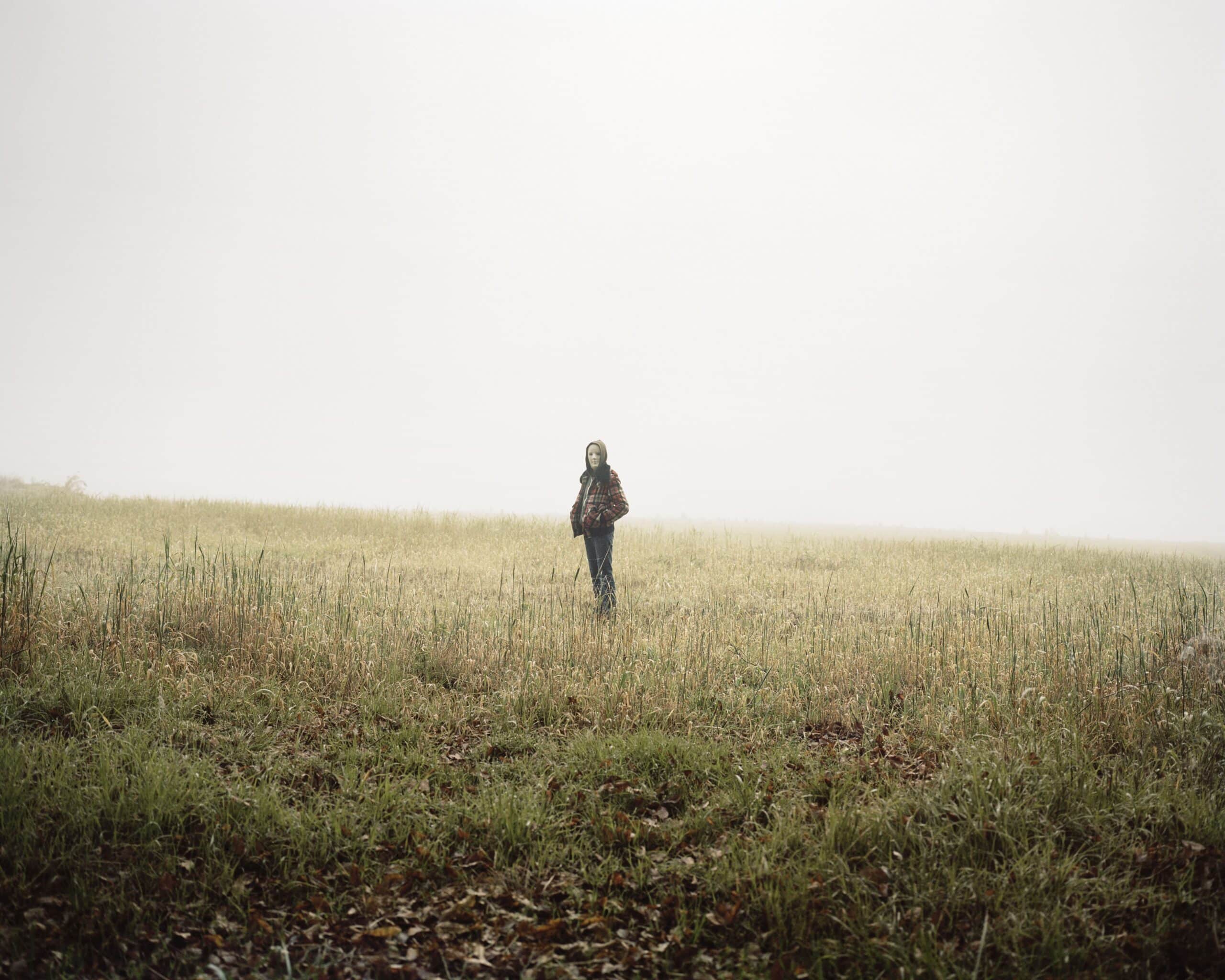
Garçon masqué
Issu de la série The Wait, 2015
© Ed Alcock / MYOP 2025
Guide d'exposition
Textes de salles
Ed Alcock. Secrets et mensonges
Depuis maintenant quatre ans, le Jeu de Paume présente au château de Tours le ou la lauréat·e du prix Niépce Gens d’images de l’année précédente. Créé en 1955, le prix récompense chaque année l’oeuvre d’un ou d’une photographe professionnel·le français·e, ou étranger·ère résidant en France depuis plus de trois ans, et ayant moins de 50 ans.
En mai 2025, le prix a été attribué à Ed Alcock, dont la candidature était parrainée par Dominique Gaessler. Né à Norwich (Royaume-Uni) en 1974 et installé en France depuis 2000, Ed Alcock, membre de l’agence Myop, poursuit un travail personnel, en marge de ses travaux éditoriaux pour la presse, notamment le New York Times mais également The Guardian, Le Monde ou El País.
Avec « Secrets et mensonges », Ed Alcock réunit quinze ans de travail photographique consacré à la famille, à la transmission et au sentiment d’appartenance. Le titre renvoie à ces secrets de famille, souvent confortables, que l’on finit parfois par percer ou reconnaître, et qui constituent un fil rouge de sa pratique depuis ses débuts. Ed Alcock décrit sa pratique photographique comme une « exploration intime et narrative du réel ». Sa méthode est à la croisée des genres autobiographique, documentaire, fictionnel. De l’autobiographie, elle reprend la dimension personnelle, puisque, de manière différente, chacune de ses séries s’ancre profondément dans l’histoire de leur auteur, qu’elle porte sur la relation avec sa famille proche, sur la question de la paternité, qu’elle rende compte de son pays d’origine ou de l’évolution sociale sur plusieurs générations. Du documentaire, elle emprunte l’approche directe, souvent posée et frontale, où son travail, sous-tendu par une volonté d’enquêter, mêle des images de natures diverses, le plus souvent prises par lui mais parfois simplement trouvées. De la fiction enfin, elle retient un goût des non-dits, construisant des images qui suggèrent davantage qu’elles ne montrent, et recourant dans certains cas au dessin, voire au film, pour compléter et prolonger un ensemble.
L’exposition est construite autour de cinq séries, réalisées entre 2009 et 2025 : centrée sur la figure de son fils Nino, Hobbledehoy (2013) traite de la fin de l’enfance et du passage à l’adolescence ; Love Lane (2014) et The Wait (2015) sont deux variations sur un même secret de famille ; Home, Sweet Home (2016-2020) sonde, à l’heure du Brexit, le lien au pays natal et les fondements d’une identité nationale ; enfin, Buried Treasure (2025) revient sur un récit familial fondateur et sur ses zones d’ombre, en opposant la force du mythe à la réalité, prosaïque et quotidienne, des lieux.
Le parcours général de l’exposition, chronologique, obéit au modèle photographique du dézoomage, allant des travaux les plus intimes et anciens aux productions plus récentes, qui adoptent une approche documentaire affirmée.
For four years the Jeu de Paume has been exhibiting the work of the previous year’s winner of the Niépce Gens d’Images Prize at the Château de Tours. Created in 1955, this annual prize is awarded to a professional photographer under the age of fifty who is either French or has been living in France for over three years.
In May 2025 the prize was awarded to Ed Alcock, whose candidacy was sponsored by Dominique Gaessler. Born in Norwich (United Kingdom) in 1974, Alcock has been living in France since 2000 and is a member of the Myop agency. For over fifteen years, he has been pursuing personal projects in parallel with press assignments, notably for The New York Times, The Guardian, Le Monde and El País. “Secrets and Lies” spans fifteen years of photographic work devoted to the family, transmission and the sense of belonging. The title refers to family secrets and convenient stratagems that are sometimes exposed and discredited, a theme that has been present in his work from the outset.
Alcock describes his photographic practice as an “intimate and narrative exploration of the real”. His method lies at the intersection of the autobiographical, documentary and fictional genres. It embodies the personal approach of autobiography, for in its own way each of the series is deeply rooted in the author’s own history, exploring his relationships with close family members, the question of paternity, one’s relation to one’s native country and social change over several generations. From the documentary it takes a direct and often posed and frontal approach, which sometimes involves an underlying investigative intent and combines various types of images, usually taken by him but sometimes simply found. Finally, from fiction it borrows a predilection for the unspoken, constructing images that suggest more than they show, and in certain cases using drawing or film to complete and extend the ensemble.
The exhibition is structured around five series created between 2009 and 2025. Hobbledehoy (2013) is centred on his son Nino and explores the end of childhood and the transition to adolescence; Love Lane (2014) and The Wait (2015) are both variations on the family secret; Home, Sweet Home (2016–20) is an examination of people’s attachment to their native country during Brexit and the nature of national identity; and Buried Treasure (2025) revisits a fundamental family legend and its grey zones, contrasting the power of this myth with the prosaic, everyday reality of the places concerned. The exhibition’s overall layout is chronological. As if zooming out, it proceeds from the oldest, most intimate works to more recent ones that adopt a resolutely documentary approach.
Hobbledehoy, 2013
Hobbledehoy traite du passage de l’enfance à l’adolescence. Le titre lui‑même, issu du vieil anglais, que l’on pourrait traduire par « dadais », renvoie à cet âge incertain, entre deux états. Cette idée se retrouve dans la structure du travail photographique, où deux types d’images se répondent. D’un côté, des scènes lumineuses et chaleureuses, baignées d’une lumière estivale et méditerranéenne, centrées sur la mère et l’enfant ; de l’autre, des images plus verdoyantes, où apparaissent un jardin et des jouets, déjà à l’abandon : un contraste visuel qui suggère une transition, un basculement progressif d’un âge à un autre.
Le projet prend aussi une dimension autobiographique et cyclique.
En regardant son fils grandir, Alcock se souvient de sa propre enfance et de son père qui lui chantait : « Ce n’était ni un homme ni un garçon ; ce n’était qu’un hobbledehoy ». L’artiste reconnaît dans son fils une posture, une mélancolie qui font écho à ses propres expériences passées. La photographie devient un espace de résonance entre générations, où se mêlent mémoire personnelle et observation du présent. Dans Hobbledehoy, ouvrage paru en 2013, les photographies d’Alcock sont accompagnées d’un récit, La Pièce fermée, écrit par Emmanuel Carrère. Le texte, ici lu par l’auteur, met des mots sur une émotion universelle : la douleur douce et paradoxale ressentie par les parents face à leurs enfants qui grandissent. Il souligne également une tension féconde chez Alcock, à la fois artiste et père, capable de transformer cette expérience intime en une oeuvre à la fois sereine et profondément bouleversante.
Hobbledehoy is about the journey from childhood to adolescence. The title, an Old English word that might be rendered today as “a clumsy, awkward youth”, evokes the uncertain period between two states of being. That idea is echoed in the way the series creates a dialogue between two types of image: on the one hand, warm, luminous scenes centered on mother and child, bathed in summery Mediterranean light; on the other, greener images showing a garden and toys, already abandoned. This visual contrast suggests the gradual transition from one age to another.
The project also has a cyclical, autobiographical dimension. Watching his son grow up, Alcock recalls his own childhood and the words sung to him by his father: “He was neither a man nor a boy; he was but a hobbledehoy”. In his son he recognises a certain melancholic stance that echoes his own past experiences. Photography becomes a field of resonance between generations that blends personal memory and observation of the present. In Hobbledehoy, published in 2013, Ed Alcock’s photographs accompanied by a short story by Emmanuel Carrère, La Pièce fermée.
The text, here read by the author, describes a universal emotion: the poignant, paradoxical sadness parents feel when their children grow up. It also highlights the productive tension in Alcock’s work, for as both an artist and a father he is able to transform that intimate experience into work that is both serene and deeply moving.
Love Lane, 2014 et The Wait, 2015
Au décès de son grand-père Harry, Ed Alcock retourne à Sleaford, petite ville rurale de l’est de l’Angleterre où il avait l’habitude de passer ses vacances d’enfance. Ce retour, à la fois bref et douloureux, ravive un lien ambivalent avec ce lieu, à la fois familier et étranger après des années d’éloignement. Il entreprend de photographier la vie locale, d’abord les paysages urbains, puis il se concentre sur les habitants, notamment les jeunes adultes et les retraités.
Peu à peu, Alcock comprend que cette attirance pour certaines figures est liée à un secret familial : l’existence d’un demi-frère caché. Cette révélation, gardée sous silence, a profondément affecté sa relation avec son grand-père. À travers les photographies de Love Lane, mêlant couleur et images floues en noir et blanc, il explore et dévoile progressivement ce passé enfoui, amorçant ainsi un processus de libération et, peut-être, le désir inavoué de retrouver ce frère inconnu. Réalisé un an après Love Lane, The Wait lui fait écho : « L’attente commence par une image. Un garçon, qui attend au bord d’un champ, enveloppé dans la brume. La scène ne le précise pas, mais je sais qu’il attend son père. Un père qui ne se montre jamais. Comment je le sais ? Je n’en ai aucune idée, je le sais, c’est mon rêve, après tout. Suis-je le garçon ? Le père ? Ou un spectateur, comme quelqu’un assis dans une salle de cinéma attendant que l’action commence ? ».
Chacune à leur manière, les deux séries interrogent la construction de l’identité et les traces invisibles que les histoires familiales laissent en nous, mêlant intimité, imaginaire et réflexion sur l’appartenance.
Following the death of his grandfather Harry, Ed Alcock returns to Sleaford, a small rural town in the east of England where he spent his childhood summer holidays. This brief but painful journey rekindled his ambivalence about the place, now both familiar and foreign, after years spent away. That experience of homecoming led him to photograph local life – first the urban landscapes and then the inhabitants, particularly young people and retirees.
Little by little he came to understand that the appeal certain people hold for him is linked to a family secret: a hidden half-brother. The revelation of that secret had a profound effect on his relationship with his grandfather. In the photographs of Love Lane, which blend colour and hazy black and white images, Alcock explores and progressively discloses that concealed history, thus setting in motion a process of liberation – and perhaps the unspoken desire to find this unknown brother.
The Wait, created a year after Love Lane, echoes that earlier series: The Wait starts with an image. A boy, waiting at the edge of a field, shrouded in mist. It’s not clear from the scene, but I know he’s waiting for his father. A father who never appears. How do I know? No idea – it’s my dream after all. Am I the boy? The father? Or a spectator, like someone sitting in a movie theatre waiting for the action to begin?”
In its own way, each series examines the construction of an identity and the invisible traces left by family histories, blending intimacy, imagination and a reflection on belonging.
Home Sweet Home, 2016 - 2020 et Mes ancêtres (et les) Gaulois, 2018
Ces deux séries explorent les conséquences humaines et identitaires du Brexit, suivant une approche à la fois personnelle et documentaire. Il s’agit avant tout du parcours d’un photographe britannique installé en France, qui, après s’être senti exclu suite au référendum de 2016, a choisi de demander la nationalité française tout en interrogeant, dans son travail, la notion d’appartenance nationale. À travers des portraits variés de Britanniques et des montages visuels symboliques, Ed Alcock exprime un regard à la fois critique, ironique et engagé en faveur de l’Europe, en questionnant ses propres racines.
Dans le même temps, il s’intéresse à la période de basculement survenue entre le référendum et la sortie effective du Royaume-Uni de l’Union européenne en 2020. Son travail explore l’écart entre les promesses simplistes des soutiens du Brexit et la réalité longue et complexe du processus. À partir de témoignages recueillis dans tout le pays, il met en lumière la diversité des émotions ressenties par ses concitoyen•nes et souligne que le Brexit est avant tout une expérience profondément personnelle : dépassant largement la sphère politique, le Brexit touche à l’identité, au sentiment d’appartenance et au vécu individuel, révélant une société divisée et en questionnement.
Following the death of his grandfather Harry, Ed Alcock returns to Both series explore the human and identity-related consequences of Brexit through an approach that is both personal and documentary. It is, first and foremost, the journey of a British photographer living in France, who requested French citizenship due to a feeling of exclusion after the 2016 referendum, and who in his work examines the notion of national identity. In various portraits of Britons and symbolic visual montages, Ed Alcock adopts a critical, ironic vision that reveals his commitment to Europe, while probing his own roots.
In parallel, he examines the critical period between the referendum and the United Kingdom’s effective departure from the European Union in 2020. He explores the gap between the simplistic promises made by the advocates of Brexit and the long, complex reality of the actual process of leaving. In testimonials gathered throughout the country, he reveals the varied reactions of his compatriots, demonstrating that Brexit was above all a profoundly personal experience. Extending far beyond the realm of politics, Brexit was bound up with identity, a sense of belonging, and individual experience, revealing a divided society in the throes of doubt.
Buried Treasure, 2025
« Avant ce projet, je n’étais jamais venu à Horden, le berceau de ma famille maternelle.
Je m’étais forgé, à partir des histoires racontées par ma mère et ses soeurs, une image fantasmée de ce village côtier de mineurs dans le nord-est de l’Angleterre. Des générations de gueules noires qui ont trimé sous la terre, jusqu’à la mort accidentelle, au fond de la mine, de mon grand-oncle Kendon, à seulement 17 ans. Cette tragédie constitue la colonne vertébrale du récit de ma famille transfuge de classe, hantée par un sentiment de trahison de ses origines. Kendon représente cette figure sacrificielle qui a contribué à hisser la Grande-Bretagne au premier rang des nations industrielles. Intrigué par ces histoires, j’ai décidé qu’il était temps de percer la réalité de ce lieu mythique et de me confronter à l’existence contemporaine du village. Un lieu où j’aurais pu grandir, si le décès de Kendon n’avait pas poussé son frère, mon grand‑père, à partir vers le sud pour devenir métayer. Au cours de mes recherches, plus je creusais, plus je découvrais la faiblesse des récits, notamment que les circonstances de la mort de Kendon étaient une fiction. La réalité me fuyait. »
“Before this project I had never been to Horden, where my mother’s family came from.
Listening to the stories told by my mother and her sisters, I had constructed an imaginary coastal mining village in northeast England. Generations of coal miners who toiled underground, until my great-uncle Kendon’s accidental death in a mine at the age of seventeen. That tragedy became central to the family story, that of a family that had ascended the social ladder but was haunted by the feeling of having betrayed its own roots. Kendon was considered a sacrificial figure who had contributed to Great Britain’s rise as an industrial nation. Intrigued by these stories, I decided it was time to dispel the mystery of that mythical place, to confront the village as it is today. A place where I might have grown up if Kendon’s death had not resulted in his brother’s – my grandfather’s – departure for the south, to become a tenant farmer. During my research, the more I searched, the more I discovered discrepancies in the stories, particularly those concerning the circumstances of Kendon’s death, which turned out to be fictional. Reality eluded me.”