
Cinema
From Cage To Frame
Creativity and confinement in the French cinema of the 1960s
From 14 May to 01 June 2019
Jeu de Paume – Paris
In the 1960s, when artists and activists in France were challenging the stifling effects of instituted structures, fiction films were relating the same desire for freedom in a more ambiguous manner. Isolated in their suburban scrapyard, Robert Enrico’s “adventurers” (Les Aventuriers, 1968) busy themselves with various artistic and technical projects, while Pierre Étaix’s Yoyo (1965), a depressive castle owner, tries to ward off the boredom of his existence by some very inventive clowning, learning that one need only get “outside the frame” for ordinary life to become desirable again. In a sense, this cinema is about contemporary art.
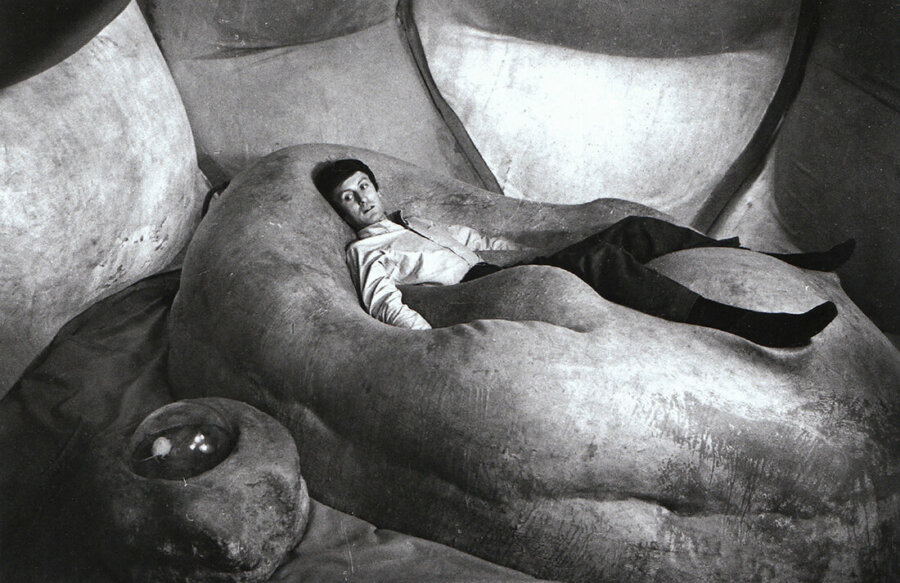
Some films, (La Prisonnière, Henri-Georges Clouzot, 1968; Le Viol, Jacques Doniol-Valcroze, 1967) refer to op and kinetic art, denouncing the ambiguity of its objectives: for while its luminous flagellations and optical grids aim to emancipate viewers from their visual and sensorial habits, or even to stimulate their creative capacities, they also establish a situation of visual domination in which the viewer’s eye is aggressed. We find the same contradiction in the Alain Resnais film Je t’aime, je t’aime, which caused quite a controversy on its release in 1968: a man is placed in a special chamber designed to stimulate his memory and imagination, but the process gets out of control and he is overwhelmed by an avalanche of images. This fantastic machine is both an engine driving the production of images and an anxiety-inducing cage that takes possession of its occupant. This contradictory position, between creativity and the inability to master what surrounds them, defines most of the situations that will be explored in this programme: confined within an illness (L’Écume des jours, Charles Belmont, 1968), on a dictatorial island (Goto, l’île d’amour, Walerian Borowczyk, 1969) or in a diabolical game (Les Créatures, Agnès Varda, 1966), the protagonists are all aware of their oppression, which arouses their desire to see and to feel.
And, paradoxically, it is on this representation of confinement that the film constructs an original discourse on freedom and creative fervour. In Les Créatures, Varda reinvents a chess game that serves as a direct metaphor of creation: it enables an imaginative novelist to manipulate the other characters, creating his novel and the film at the same time. What these cinematic fictions are saying, with their exacerbated awareness that every practice exists within frameworks (artistic, institutional, economic and social), is that the desire to get away from these is needed to stimulate the desire to create at the same time as the desire to destroy; that these frameworks are both the place of oppression and the ferment of invention: that without constraint, there can be no freedom, just as there can be no image without a frame.
Programmed by Joséphine Jibokji
Joséphine Jibokji is a lecturer in film studies at the Université de Lille. Her research speciality is the interactions between art history and fiction in cinema. Her thesis on the production of objects for the French cinema is due to be published in June (INHA/CTHS). She is the author of texts on Alain Resnais, Jacques Tati, Jacques Demy and Yves Klein and co-editor of Muséoscopies. Fictions du musée au cinéma (Presses Universitaires de Paris Ouest, 2018).