
Archive magazine (2009 – 2021)
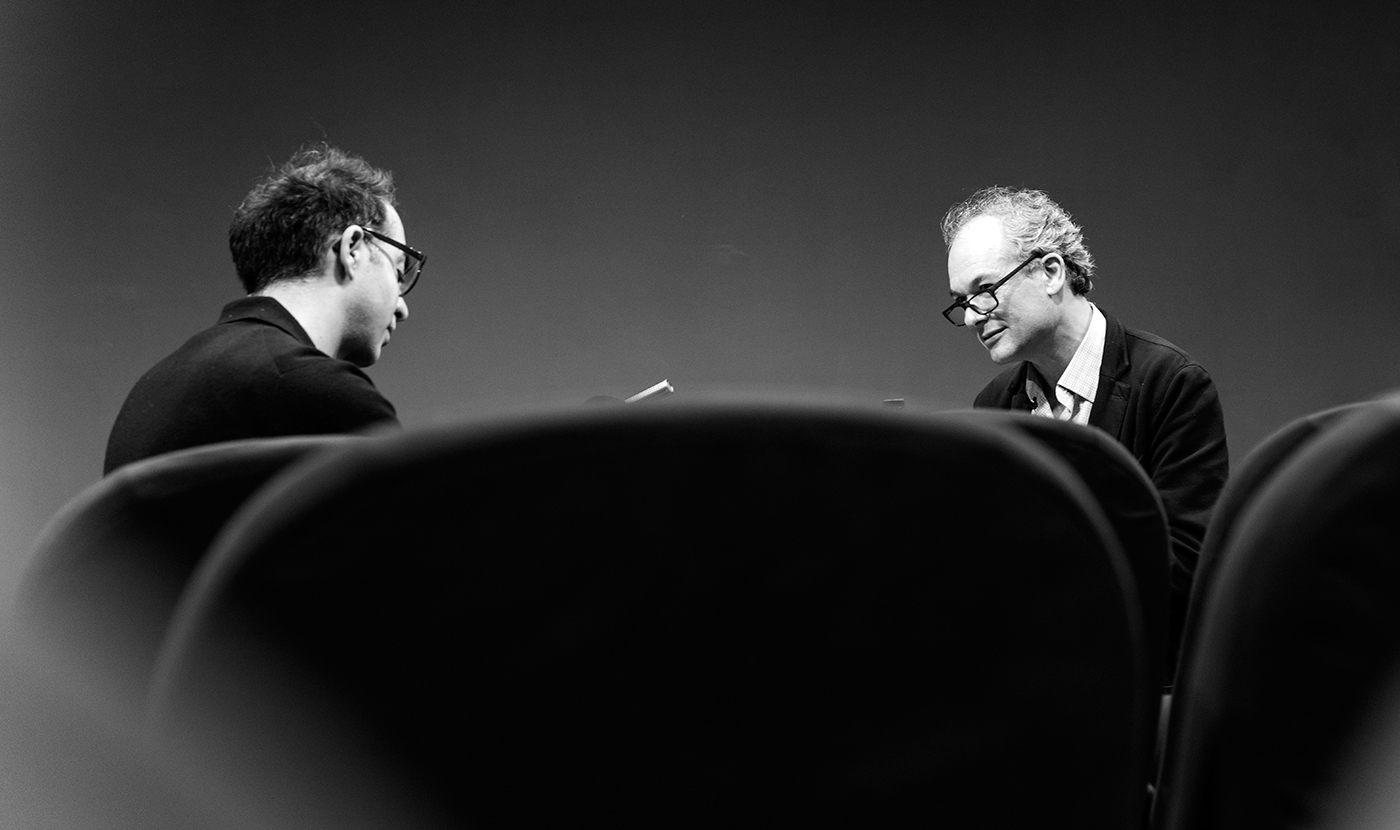
Meeting Point #2 : Dork Zabunyan & Peter Szendy
Peter Szendy is “updating” current thinking about images just as, according to Flaubert, Baudelaire, “[modernised] Romanticism” in his time.
Peter Szendy – Auscultating images
Here is a philosopher who has profoundly renewed our relationship with images, every kind of image: cinema, television, Internet, painting, and comic strips, etc. Le Supermarché du visible (published last autumn by Minuit) constitutes a salutary benchmark from which to survey a contemporary world that is saturated with images. Several reasons explain why this book, which you can read as a survival guide for people living in an age of generalised hyper-visibility, is so important. First of all, and we must insist upon this fact to avoid any misunderstandings, the conceptual thought processes that Peter Szendy suggests comprise an antidote to the pessimistic observations about the presumed effects of a visible world in overdrive. These supposed effects include derealisation: as an excess of images inexorably leads to a loss of reality or alienation, so the large-scale consumption of images necessarily leads to mass alienation. These harmful effects may indeed be a reality here and there, with local specificities (strategies implemented to monopolise the gaze vary from one country to another), but it appertains to the philosopher to outline a critique that provides a way out, or to hint at an evasive manoeuvre that allows us to glimpse an alternative. This alternative is notably embodied in Peter Szendy’s writing itself, which is yet another characteristic of Le Supermarché du visible. In this book, its author’s conceptuality is inherent to the works it deals with and therefore our image environments, as suffocating as they may be, find their salutary counterpart in moments of time and space created by filmmakers from Robert Bresson to the Marx Brothers and from Jacques Tati to Brian De Palma. Szendy accurately analyses and describes their work, whilst turning the reader away – using subtle twists and turns within the films themselves – from all the mechanisms that shape or condition our way of seeing. There are no “immediate organs” said Karl Marx, quoted by Szendy, there are only “social organs” that find in the art of images thousands of ways to emancipate themselves. This naturally results in another specific characteristic of Le Supermarché du visible, which soberly develops a politics of images, without claiming to have the last word on their final meaning. In fact, it would be more exact to say a policy for auscultating images (as Peter Szendy himself put it in the conversation that we had) because the idea is indeed to examine or auscultate, like a philosopher-doctor, the future of these images in market terms, their high-speed circulation and the cinematographic inventions that concern them – always with a view to revealing the moment when they act as counterpoints that bring rhythm, punctuate, envelope and even “phrase” our everyday lives.
Dork Zabunyan
Translation : Simon Thurston
Peter Szendy is a French philosopher and musicologist. He is the David Herlihy Professor of Humanities and Comparative Literature at Brown University and he is a lecturer at the University of Paris Nanterre and advisor for programming at the Philharmonie de Paris. Peter Szendy previously taught at Marc Bloch University in Strasbourg, while being an editorial consultant at IRCAM from 1994 to 2001. He specializes in the aesthetics of music, literature, and cinema. He is also the author of librettos of operas or vocal works. His published works include Listen: A History of Our Ears, with a foreword by Jean-Luc Nancy, Fordham University Press, 2008; Prophecies of Leviathan. Reading Past Melville, with an afterword by Gil Anidjar, Fordham University Press, 2010; Hits. Philosophy in the Jukebox, Fordham University Press, 2011; Kant in the Land of Extraterrestrials. Cosmopolitical Philosofictions, Fordham University Press, 2013; Phantom Limbs: On Musical Bodies, Fordham University Press, 2015; All Ears: The Aesthetics of Espionage, Fordham University Press, 2016.
Dork Zabunyan is Professor in Film Studies at Paris 8 University. His main publications include Foucault va au cinéma (Bayard 2011), Les Cinémas de Gilles Deleuze (Bayard 2011), Passages de l’histoire (Le Gac Press, 2013), and most recently L’insistance des luttes (De l’incidence éditeur, 2016). He contributes to Les Cahiers du cinéma, Trafic, Critique and artpress.