
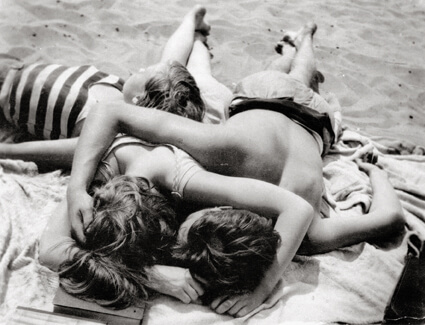
Collection privée, Berlin.
© Eva Besnyö / Maria Austria Instituut Amsterdam
Exhibition
Eva Besnyö (1910–2003): The Sensuous Image
From 22 May to 23 September 2012
Jeu de Paume – Paris
In 1930, when Eva Besnyö arrived in Berlin at the age of only twenty, a certificate of successful
apprenticeship from a recognised Budapest photographic studio in her bag, she had made
two momentous decisions already: to turn photography into her profession and to put fascist
Hungary behind her forever.
Like her Hungarian colleagues Moholy-Nagy, Kepes and Munkacsi and – a little later – Capa,
Besnyö experienced Berlin as a metropolis of deeply satisfying artistic experimentation and
democratic ways of life. She had found work with the press photographer Dr. Peter Weller and roamed the city with her camera during the day, searching for motifs on construction sites, by Lake Wannsee, at the zoo or in the sports stadiums, and her photographs were published – albeit, as was customary at the time, under the name of the studio. Besnyö’s best-known photo originates from those years: the gypsy boy with a cello on his back – an image of the homeless tramp that has become familiar all over the world.
Eva Besnyö had a keen political sense, evidenced by the fact that she fled in good time from
anti-Semitic, National Socialist persecution, leaving Berlin for Amsterdam in autumn 1932.
Supported by the circle surrounding woman painter Charley Toorop, filmmaker Joris Ivens and
designer Gerrit Rietveld, Besnyö — meanwhile married to cameraman John Fernhout — soon
enjoyed public recognition as a photographer. An individual exhibition in the internationally respected Van Lier art gallery in 1933 made her reputation in the Netherlands practically overnight. Besnyö experienced a further breakthrough with her architectural photography only a few years later: translating the idea of functionalist “New Building” into a “New Seeing”.
In the second half of the 30s, Besnyö demonstrated an intense commitment to cultural politics,
e.g. at the anti-Olympiad exhibition “D-O-O-D” (De Olympiade onder Diktatuur) in 1936; in the following year, 1937, she was curator of the international exhibition “foto ’37” in the Stedelijk Museum Amsterdam.
The invasion of German troops in May 1940 meant that as a Jew, Eva Besnyö was compelled
to go into hiding underground. She was attracted to a world view shaped by humanism in the post-war years, and her photographs became stylistically decisive for neo-Realism and immensely suitable for the moralising exhibition, the “Family of Man” (1955).
The mother of two children, she had experienced the classic female conflict between bringing
up children and a profession career as a crucial and very personal test. Consequentially, Besnyö became an activist in the Dutch women’s movement “Dolle Mina” during the 70s, making a public commitment to equal rights and documenting demonstrations and street protests on camera.
This first retrospective exhibition, showing approximately 120 vintage prints, aims to introduce the public to the life and work of this emigrant and “Berliner by choice”, a convinced cosmopolitan and
the “Grande Dame” of Dutch photography. “Like many other talents, that of Eva Besnyö was lost to Germany and its creative art as a direct consequence of the National Socialists’ racial mania.” (Karl Steinorth, DGPh, 1999)
> To watch the Eva Besnyö’s video portrait:
Curators: Marion Beckers and Elisabeth Moortgat
Exhibition organized by Das Verborgene Museum, Berlin, in collaboration with the Berlinische Galerie, Berlin, and the Jeu de Paume, Paris.
The exhibition has received support from the
Embassy of the Kingdom of the Netherlands, Paris.
In partnership with A Nous Paris, De l’air, paris-art.com,
Stiletto, LCI and Radio Nova.